
Switches of Play and Deep Completions: the numbers
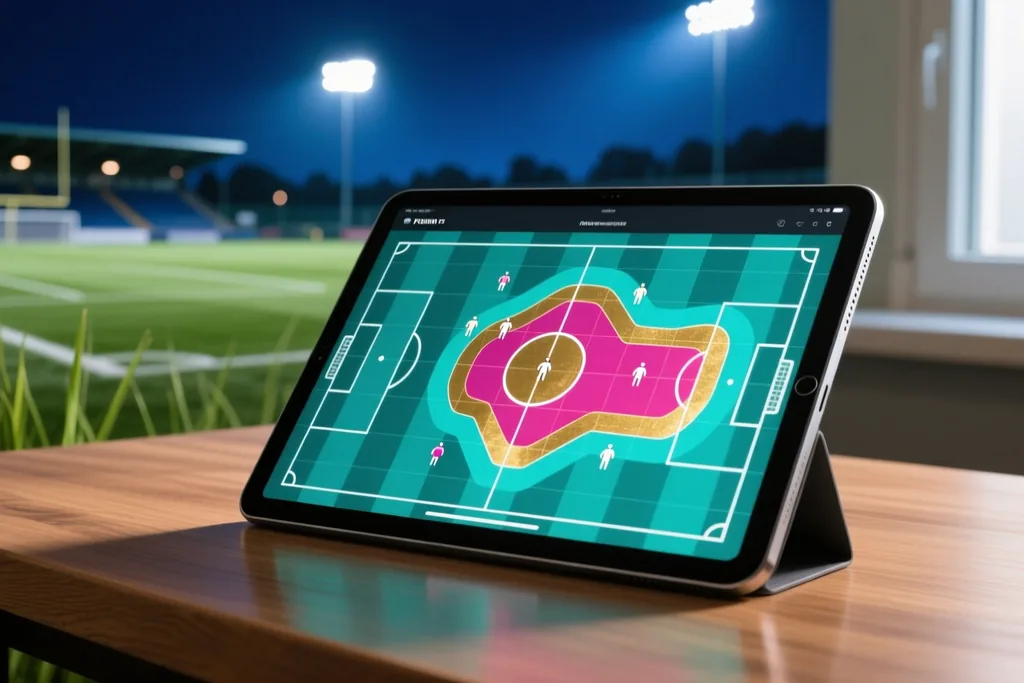
Two progression actions sit outside the standard definitions: the long switch that moves play across the whole pitch, and the completion into the space behind a defence. Both are the products of particular styles.
The switch of play
A switch is a pass that moves the ball from one side of the pitch to the other, usually over a considerable distance and often diagonally. Its purpose is to attack a defence that has shifted towards the ball, and its value is not in the distance travelled but in the isolation it creates for a receiver on the far side.
Standard progressive-pass definitions may or may not count a switch, depending on whether the ball's net forward movement crosses the threshold. That is why switches need their own count: they are a distinct behaviour whose value lies in changing the point of attack rather than in advancing the ball, and collapsing them into a progression total loses the point of them.
Why the switch works
A defence is a shifting object, and it compresses towards the ball. When the ball moves quickly to the opposite flank, the defenders must travel further than the ball to re-form, and in the interval before they arrive the receiver has space and a one-against-one or better. The measurable signature of a good switch is the distance the ball covers divided by the time it takes, which decides whether the defence can recover.
This is why switches are a feature of sides that face compact opponents. Against a defence that does not shift, the diagonal achieves nothing except moving the ball away from goal; against one that does, it is among the most efficient ways to create a numerical advantage without beating anybody.
Deep completions
A deep completion is a pass received in a defined zone close to the opponent's goal, typically within twenty metres of the byline or inside the area. It does not have to be a cross and does not have to produce a shot; it records that the ball was delivered into the most dangerous region of the pitch.
The measure matters because it captures the moment when possession becomes threat. A side can pass the ball around the final third for a whole match without completing a single pass into the danger zone, and its expected-goals total will record the consequence while the deep-completion count records the cause. Where the two disagree, the cause is usually the more actionable finding.
The style dependence
Both measures are heavily style-dependent. A direct, counter-attacking side accumulates deep completions on few possessions and almost no switches, because it attacks vertically rather than laterally. A possession side accumulates switches in vast numbers and may struggle for deep completions against a deep block that congests the zone.
The consequence is that neither number can be ranked across all teams without distortion. The informative comparison is between sides that attack in similar ways, and the informative statement is a description of method rather than a claim about quality. A switch count is a fingerprint, and fingerprints do not rank.
Reading them together
The pair describes a team's lateral and vertical reach: how well it moves the ball across a shifting defence and how often it delivers into the danger zone. A side strong on both is able to change the point of attack and then to use it; a side strong on neither is circulating the ball without a plan for reaching the places where chances come from.
Reported with progression totals and expected goals, the four figures give a reasonably complete account of how a team attacks. The switches explain the lateral movement, the deep completions explain the final delivery, the progression total explains the territory, and the expected goals record what it all produced.
Reporting the definitions
Both terms require their thresholds. A switch needs a minimum width of travel, and a deep completion needs the boundary of its zone, typically measured from the goal line or from the edge of the area. Providers differ on both, and the differences shift the counts in the same way as every other definitional choice on this site.
The practical rule for a comparative table is to compute both from one source under one definition and to say so in the caption. Two counts of deep completions from two providers in one table is a table that will mislead every reader, including the analyst who assembled it.
Key reference points
- A switch changes the point of attack; its value is the space it isolates.
- A defence that shifts is vulnerable to a switch; one that holds is not.
- Deep completions record possession becoming threat near the danger zone.
- Both measures are style fingerprints and should not be ranked across all teams.
- Report switches, deep completions, progression and expected goals together.
- State the switch width and the completion zone in every caption.
| Measure | Describes | Style it favours |
|---|---|---|
| Switches of play | Lateral reach | Possession sides facing compact blocks |
| Deep completions | Ball delivered near goal | Direct and counter-attacking sides |
| Progressive passes | Territory gained | Any build-up side |
| Crosses | Deliveries from wide | Sides with aerial targets |
| Cut-backs | Delivery across the face | Sides attacking the byline |
Switches measure lateral reach and deep completions measure vertical delivery, and a team needs an answer to both questions before it can be said to have an attacking plan.